
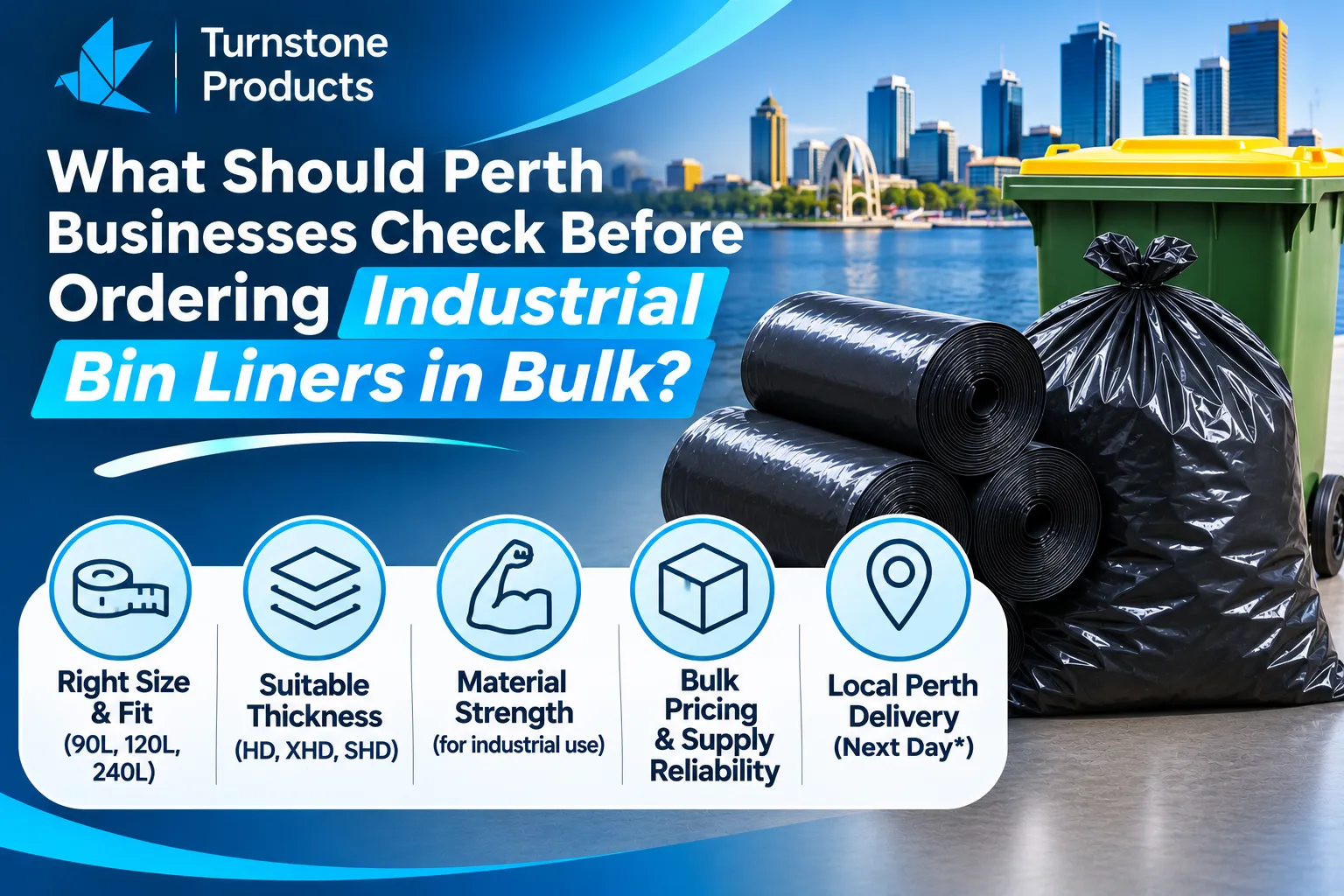
Quick answer: Before ordering bin liners in bulk, walk your site and record every bin’s size, location and the waste it collects. Match a liner size and grade to each bin type, trial samples, work out monthly usage and convert it to full cartons, then check storage space, cost per liner and the supplier’s delivery terms. That way the cartons that arrive are the ones you actually need.
Bulk buying bin liners makes sense for most commercial sites: fewer orders and a lower price per bag. But a pallet of the wrong liners is an expensive mistake. Bags that do not fit, or a grade too light for the waste, can sit in the storeroom for months.
For warehouses, restaurants, manufacturing sites and cleaning contractors in Perth, a little homework pays off. Before buying wholesale commercial bin liners, work through the checks below.
Check 1: Do a Quick Bin Audit
Most businesses do not know exactly how many bins they have or what goes into each one. Spending 30 minutes walking the site fixes that.
Grab a clipboard or a phone and record each bin’s:
-
Location
-
Capacity and measurements
-
Type of waste it collects
-
How often it is emptied
Here is what a simple audit might look like for a small warehouse with an office and lunchroom:
|
Location |
Bin |
Waste type |
Liner needed |
|
Office desks |
54L |
Paper, light packaging |
General purpose |
|
Lunchroom |
72L |
Food scraps, wet waste |
Extra heavy duty |
|
Packing area |
120L |
Cardboard offcuts, film |
Heavy duty |
|
Loading dock |
240L wheelie bin |
Strapping, pallet waste |
Extra heavy duty |
Illustrative example only. Your site will differ.
This table shows how many liner types you need and which grades matter. It also stops you ordering one “do everything” liner that is overkill in some bins and too weak in others.
Check 2: Measure, Don’t Assume
Litre capacity is a starting point, not a guarantee. Two 120L bins from different manufacturers can have quite different shapes.
For each bin type, measure:
-
The opening: width and depth across the top.
-
The height: from the inside floor to the rim.
-
The shape: whether the bin tapers towards the bottom.
-
The overhang: allow enough material to fold securely over the rim.
A well-fitted liner reaches the bottom without stretching and still grips the edge. As a general guide, common sizes are used like this:
|
Liner capacity |
Typical use |
|
54L |
Offices and retail premises |
|
72L–80L |
Commercial cleaning and general workplace bins |
|
90L |
Larger indoor commercial bins |
|
120L |
Communal bins and commercial facilities |
|
240L |
Industrial sites and compatible wheelie bins |
Always check your bins’ measurements against the supplier’s listed liner dimensions.
Check 3: Choose the Right Grade for Each Bin
Liner thickness is measured in microns. One micron is a thousandth of a millimetre. In Turnstone Products’ range, general purpose liners are around 20 microns, heavy duty 25, extra heavy duty 30 and super heavy duty 38 in selected sizes. Other manufacturers may differ.
Thicker is not automatically better. The plastic blend, seal quality and correct fit all affect performance. Base the grade on the waste in each bin, using your audit:
-
Light, dry waste such as paper suits general purpose.
-
Mixed commercial rubbish usually needs heavy duty.
-
Wet, dense or bulky waste calls for extra heavy duty.
-
Only the toughest loads need super heavy duty.
When looking at industrial bin liners Perth suppliers offer, resist the urge to buy the thickest grade for every bin. You will pay for strength you do not need in the office and lunchroom.
Sharp or hazardous waste should never go into ordinary liners. Use designated rigid containers for it.
Check 4: Trial Samples First
A trial shows what a liner actually does with your waste. Ask for samples of each size and grade from your audit, use them for a week, and check:
-
Does each liner fit its bin and stay put around the rim?
-
Does it hold a full load without the bottom seal failing?
-
Does it resist punctures from normal rubbish?
-
Can staff lift it out without it stretching or tearing?
If a liner fails, adjust the size or grade before you commit to cartons of it.
Check 5: Work Out How Many You Need
Bulk quantities should come from real usage, not guesswork. Take one liner type at a time.
Say the warehouse uses 20 extra heavy duty liners a day across 22 operating days a month:
20 liners × 22 days = 440 liners a month
Add 60 liners as reserve stock for busy weeks or late deliveries, and the target is 500 liners.
If 120 usable liners are already on the shelf, the business needs 380 more. With a hypothetical carton of 250 liners, that rounds up to two cartons. The extra liners count towards next month.
Carton quantities vary by product and supplier, so check them on your quote.
Check 6: Compare Cost Per Liner, Not Carton Price
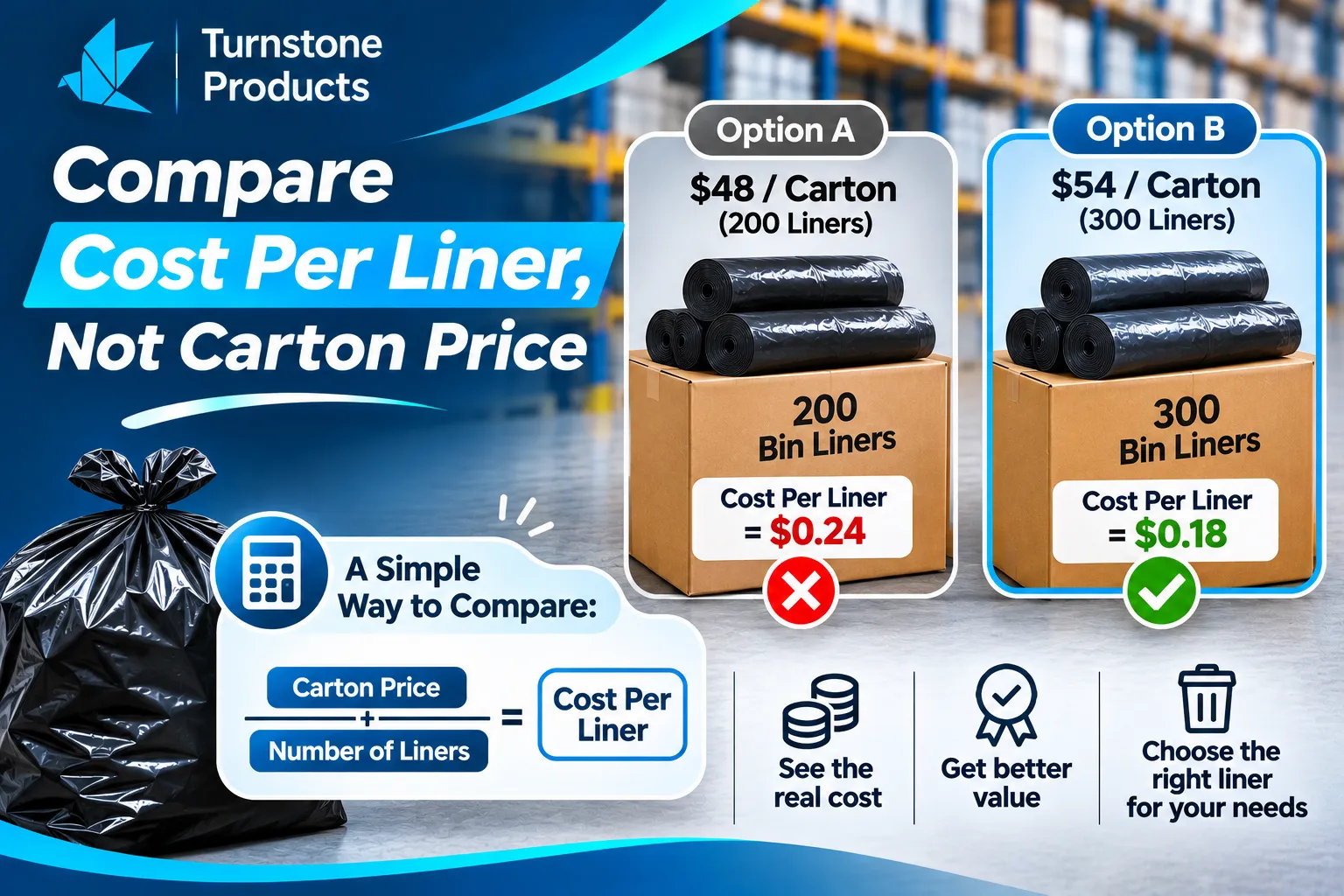
Cartons hold different numbers of bags, so carton prices can mislead.
|
Details |
Supplier A |
Supplier B |
|
Carton price |
$50 |
$60 |
|
Liners per carton |
200 |
300 |
|
Cost per liner |
$0.25 |
$0.20 |
Hypothetical figures for illustration.
Supplier B is cheaper per bag, but only compare liners of the same size and grade, and add any freight charges.
Check 7: Plan Where the Stock Will Go
A bulk order needs somewhere to live. Before ordering, make sure you have dry, clean storage space for the cartons. Keep liners out of direct sunlight, which can weaken plastic over time, and away from heat sources. In a Perth summer, a carton left on a sunny loading dock is not ideal.
Use older stock first.
Check 8: Ask Your Supplier the Right Questions
Businesses choosing a heavy duty bin liner Perth supplier should ask:
-
Which sizes and grades do you stock?
-
How many liners are in each carton?
-
Do you offer bulk pricing, and can you provide an itemised quote?
-
What are the delivery charges and how quickly do orders arrive?
-
Will the same product be available every time we reorder?
-
Can you help us match liners to our bins?
Reliable delivery lets you hold less reserve stock.
Why Choose Turnstone Products?
Turnstone Products is a Western Australian, family-owned supplier of commercial cleaning products and workplace consumables, based in Neerabup. It supplies bin liners to commercial cleaners, hospitality venues, warehouses and industrial sites across Perth.
-
A broad liner range. Kitchen tidy bags plus 54L, 72L, 80L, 90L, 120L and 240L commercial liners.
-
Four grades. General purpose, heavy duty, extra heavy duty and super heavy duty in selected sizes.
-
Itemised bulk quotes. Bulk buyers contact the team for carton and larger-quantity pricing.
-
Help with sizing. The team can help match liner sizes and grades to your bins and waste.
-
Next-business-day delivery. Eligible Perth metro orders, from Yanchep to Mandurah, arrive the next business day, with Australia-wide supply for bulk orders.
Frequently Asked Questions
Are industrial bin liners stronger than regular bin bags?
Industrial liners come in heavier grades for tougher waste, but real strength depends on the material, thickness and seal quality, not just the label.
Is buying commercial bin liners in bulk cheaper?
Usually per bag, but compare delivery costs, quality and how many you actually use before ordering large quantities.
What size liner suits a 240L wheelie bin?
A 240L liner is the usual choice, but check your bin’s measurements against the liner’s dimensions before ordering in bulk.
Conclusion
A bulk order of bin liners should come from a plan, not a guess. Audit your bins, match each to the right size and grade, trial samples, calculate real usage, compare cost per liner and make room for the stock. Perth businesses that do this get liners that fit, last and arrive when needed.
