
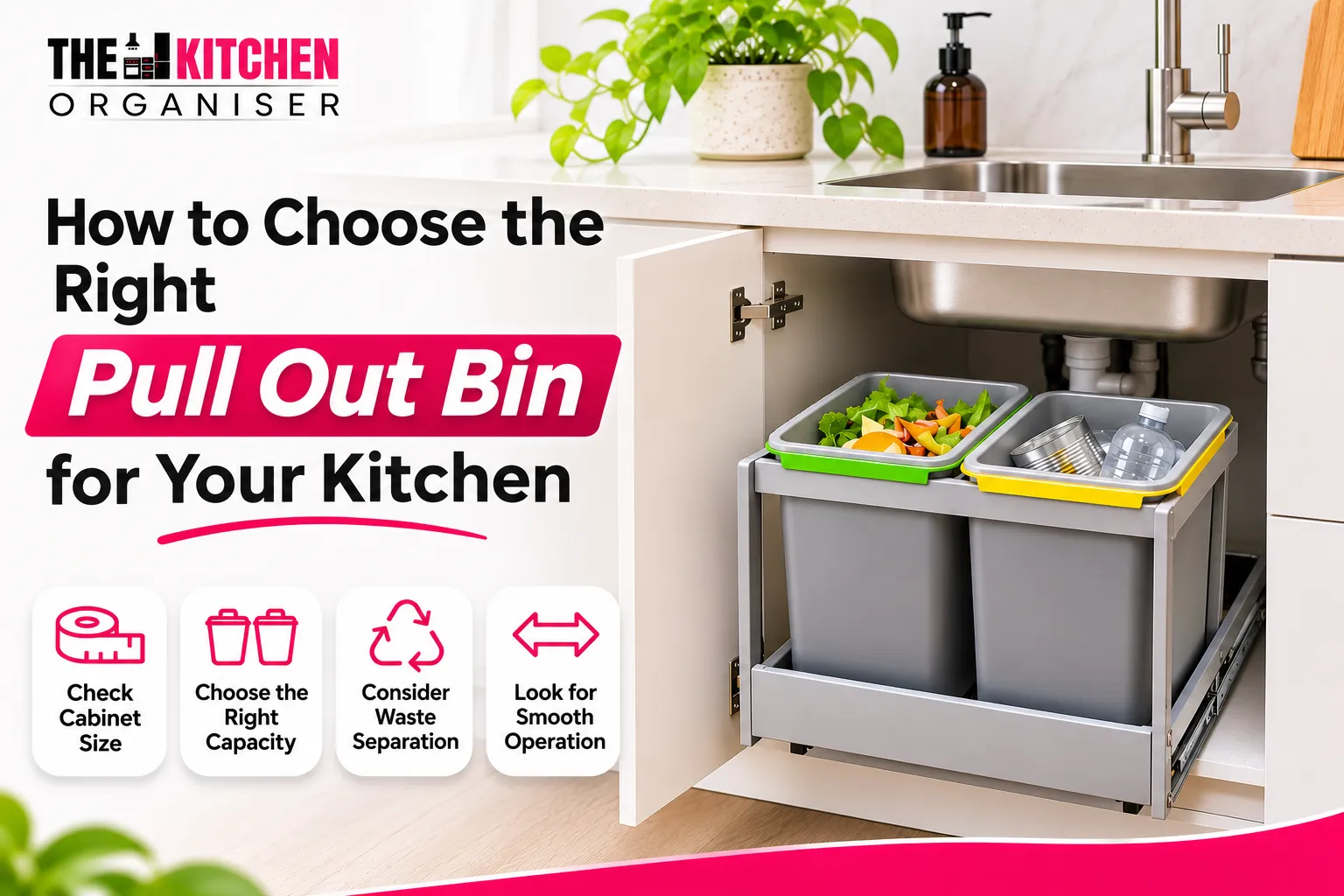
A freestanding bin in a busy kitchen is always in the wrong place. It’s too far from the chopping board, in the way of the dishwasher, or knocked over by whoever is walking past. A pull out bin fixes that by living inside a base cabinet and sliding forward on runners when you need it. The trick is choosing one that suits your cabinet and your household. Kitchen pull out bins vary a lot in width, height, bucket size and mounting style, and a bin that’s a few millimetres too wide won’t fit. This guide covers capacity, measuring, configurations and the features worth paying for.
Quick answer: To choose a pull out bin, measure your cabinet’s internal width, depth and height, then match the capacity to your household: around 20–35 litres for one or two people, 35–60 litres for a family of three to four, and 60–70 litres or more for larger households. Choose a double bin if you separate recycling, and check runner quality and plumbing clearance before you buy.
Why Choose a Pull Out Bin Over a Freestanding Bin?
A pull out bin uses space inside a cabinet instead of floor space, slides out to sit right under the benchtop when you need it, and hides rubbish when the door is closed. Double models also make recycling easier by keeping two buckets side by side.
-
Clears the floor and hides waste behind a closed door.
-
Brings the bin to you: full-extension runners pull the buckets clear so you can scrape plates straight in.
-
Takes heavy loads: the runners carry the weight, not the door hinges.
What Size Pull Out Bin Do You Need?
Most households need between 30 and 60 litres in total. Singles and couples suit 20–35 litres, families of three to four suit 35–60 litres, and larger households suit 60 litres or more, usually split across two buckets.
|
Household |
Suggested total capacity |
Example configuration |
|
Single person |
15–25 litres |
One 19-litre bucket |
|
Couple |
25–35 litres |
30-litre single, or 2 × 17 litres |
|
Family of 3–4 |
35–60 litres |
2 × 26 litres or 2 × 30 litres |
|
Larger household |
60–80 litres |
2 × 32 litres or 2 × 35 litres |
Most Australian councils collect general waste weekly or fortnightly, so think about how long rubbish sits in the cabinet. If you use a separate FOGO caddy for food scraps, you can often drop a size for general waste.
How Do You Measure a Cabinet for a Pull Out Bin?
Measure four things: the internal width at the narrowest point, the depth from the back of the closed door to the rear panel, the clear height to the lowest obstruction, and the door and hinge clearance. Compare each one with the minimum cabinet size listed for the bin.
-
Internal width: measure between the side panels, not the cabinet’s outside size. A 450 mm cabinet typically gives you around 410–420 mm once you subtract the panels and hinge plates, and that’s the number the bin frame must fit.
-
Depth: measure from the back of the closed door to the back panel, or to the nearest pipe if it’s a sink cabinet.
-
Height: measure from the cabinet floor to the underside of any shelf, sink bowl or trap. Under a sink, a reduced-height model such as the Wesco 30L Shorty is designed to clear the plumbing.
-
Door clearance: check whether the bin is pulled by hand or linked to the door, and that the door opens wide enough for the frame to slide fully out.
As a rough guide, slim single kitchen pull out bins suit 300 mm cabinets, compact doubles suit 400–450 mm, and large doubles suit 450–600 mm. Always confirm against the product’s installation details.
Single or Double Pull Out Kitchen Bins?
Choose a single bin for narrow cabinets, small households or kitchens where recycling is kept elsewhere. Choose a double for most family kitchens, where rubbish and recycling go in side-by-side buckets.
The one thing to check with double pull out kitchen bins is the size of each bucket. A 40-litre double usually means two 20-litre buckets, and a 64-litre double means two 32-litre buckets. If general waste fills up fastest in your home, pick a model where each bucket is large enough to last until bin night.
Which Pull Out Bins Suit Which Kitchens?
The best pull out bin depends on your cabinet and household, but a few configurations cover most Australian kitchens:
-
Small kitchens and apartments: a compact 19-litre single from the Kia Ora OPTIO range.
-
Most couples and small families: a Kia Ora 34L OPTIO double (2 × 17 litres), which suits a wide range of cabinets.
-
Families who cook daily: a Kia Ora 52L (2 × 26 litres) or 60L (2 × 30 litres) OPTIO double.
-
Large households: the Wesco 64L double (2 × 32 litres) or Kia Ora 70L (2 × 35 litres), both mounted on the cabinet base.
-
Under-sink cabinets: the Wesco 30L Shorty, whose reduced height clears the trap and pipes.
If your cabinet is narrow or crowded with pipes, a door mounted bin may suit you better.
What Features Should a Pull Out Kitchen Bin Have?
The features that matter most are full-extension runners, removable buckets, a sturdy frame and mounting that suits your cabinet.
-
Full-extension, soft-close runners: the bin comes fully clear and closes quietly.
-
Removable buckets with handles: easy to empty and wash.
-
Sturdy frame: a base-mounted frame handles full buckets better than a light wire rack.
-
Mounting style: base-mounted, side-mounted or door-linked, to suit your cabinet.
Can You Fit a Pull Out Bin to an Existing Cabinet?
Yes. Most pull out bins are designed to retrofit into existing base cabinets with no renovation, as long as the cabinet floor is solid enough to screw into and the internal size matches the bin’s minimum requirements.
Remove any shelf in the way, and in a sink cabinet make sure the frame clears the pipes and the isolation valves stay reachable. If you’re not confident with runners, a handyperson can fit one quickly.
How Do You Keep a Pull Out Bin Clean?
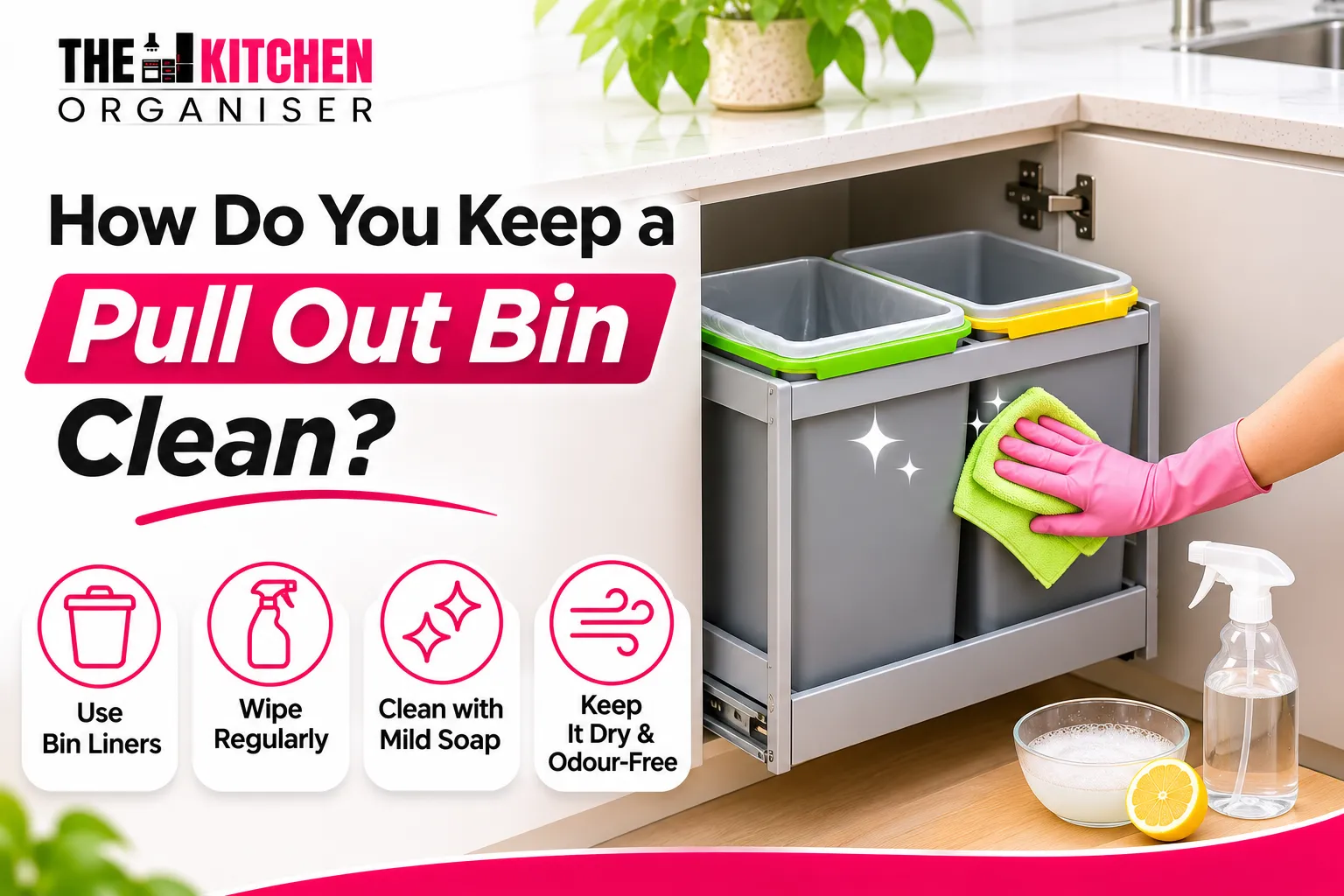
Empty food scraps often, wash buckets in warm soapy water every week or two, and let them dry fully before refitting. Wipe crumbs and spills off the runners, use liners sized to the bucket, and check the cabinet floor for moisture, especially under the sink.
Why Choose The Kitchen Organiser?
The Kitchen Organiser has a dedicated range of pull out kitchen bins for Australian cabinets, alongside its wider kitchen bins collection.
-
Wesco and Kia Ora pull-outs from 19-litre singles to 70-litre doubles.
-
Under-sink and reduced-height models such as the Wesco 30L Shorty.
-
Replacement buckets to keep your bin going for years.
-
Free shipping Australia-wide on orders over $200.
About Us
The Kitchen Organiser is an Australian online store for people who want kitchens that are easier to live with. We stock kitchen bins, pull-out and corner fittings and laundry storage from trusted brands, and we focus on helping you find products that fit the space you actually have.
Frequently Asked Questions
What size pull out bin do I need?
Most households need 30–60 litres in total. One or two people suit 20–35 litres, families of three to four suit 35–60 litres, and larger households suit 60 litres or more across two buckets.
What width cabinet do I need for a pull out bin?
Slim single pull out bins suit cabinets from about 300 mm, compact doubles suit 400–450 mm, and large doubles suit 450–600 mm. Always measure the internal width and check the product’s minimum cabinet size.
Can a pull out bin go under the sink?
Yes, if the frame clears the trap and pipes. Reduced-height models such as the Wesco 30L Shorty are made for under-sink cabinets.
Are kitchen pull out bins worth it?
Yes, for most kitchens. They free up floor space, hide rubbish, make recycling easier and carry heavy loads on runners rather than door hinges.
Final Thoughts on Choosing a Pull Out Bin
The right pull out bin comes down to an accurate internal measurement, a capacity that suits your household and bin night, and a configuration, single or double, that matches how you sort waste. Get those three right and your rubbish will finally have a proper home inside the cabinet.
